

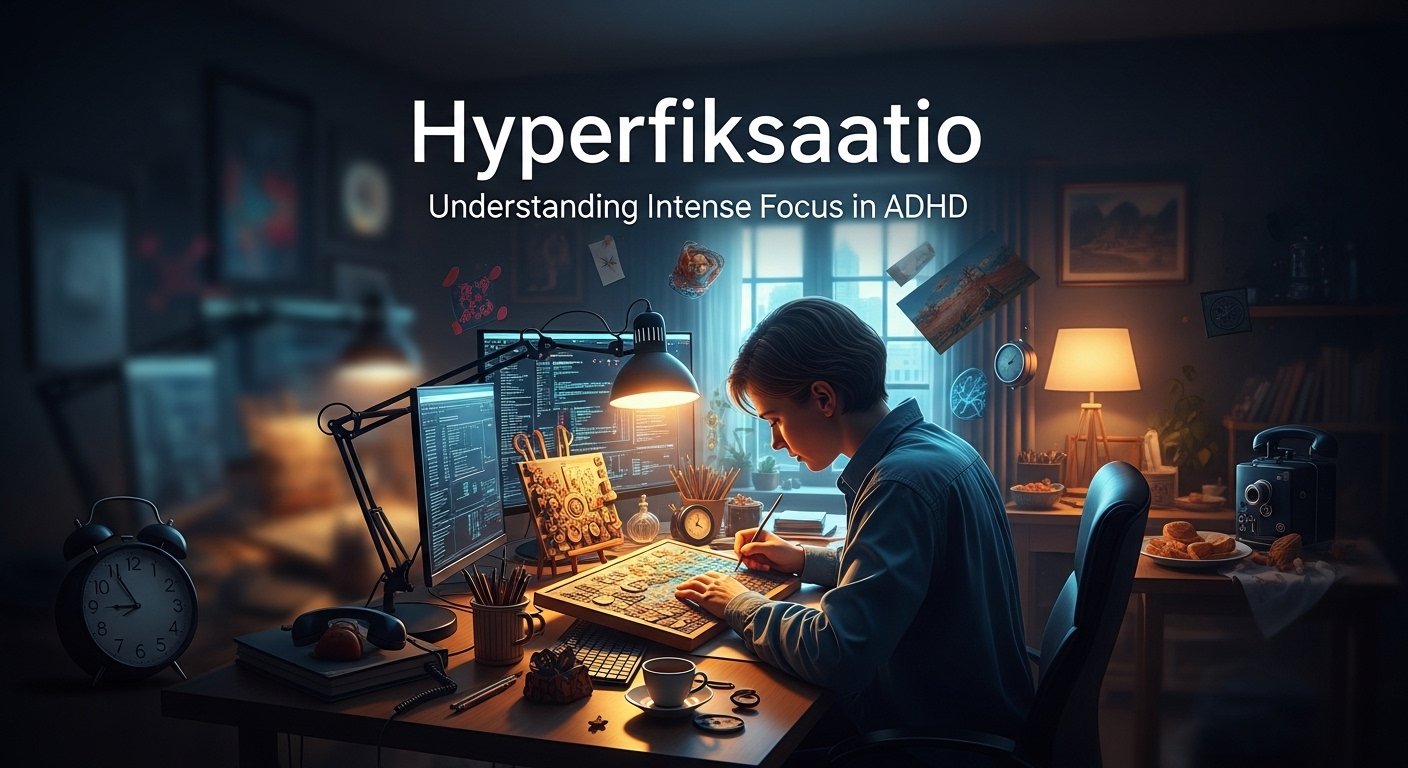
Late one evening, a founder sits glued to a glowing screen, oblivious to the time. Notifications pile up, messages go unanswered, and dinner goes cold. Hours later, the work is flawless, deeply considered, and surprisingly creative. For many entrepreneurs and tech professionals with ADHD, this isn’t rare. It’s hyperfiksaatio, a powerful mental state where attention narrows and time dissolves.
While ADHD is often framed as a struggle with distraction, hyperfiksaatio reveals the other side of the coin. It’s an intense, almost magnetic focus that can unlock bursts of productivity, creativity, and insight. Yet it also carries risks that can quietly erode balance and well-being. Understanding this paradox is essential for modern leaders navigating fast-moving industries where attention is currency.
What Hyperfiksaatio Really Means
Hyperfiksaatio is a term often used in Nordic and European discussions around ADHD to describe periods of deep, sustained focus on a single task or idea. Unlike casual concentration, it feels immersive. People experiencing it may lose track of time, ignore physical needs, and tune out external stimuli entirely.
In business and technology environments, this can manifest in familiar ways. A developer who spends twelve hours debugging a single issue without noticing hunger. A founder obsessively refining a product feature while ignoring investor emails. A designer polishing micro-interactions long after deadlines pass.
The key distinction lies in intensity. Hyperfiksaatio isn’t simply working hard. It’s entering a tunnel where attention locks in and becomes difficult to redirect, even when shifting focus would be beneficial.
The ADHD Attention Paradox
For decades, ADHD has been misunderstood as a deficit of attention. In reality, many clinicians describe it as a regulation issue rather than a shortage. Attention fluctuates dramatically. It may scatter across trivial stimuli one moment and then narrow into hyperfiksaatio the next.
This paradox often confuses managers and even individuals themselves. How can someone struggle to complete routine tasks yet produce extraordinary results under certain conditions? The answer lies in interest-driven attention. ADHD brains tend to engage deeply when tasks are novel, meaningful, or emotionally stimulating.
In entrepreneurial settings, this dynamic can create unpredictable rhythms of performance. Periods of low engagement may suddenly give way to explosive creativity when the right trigger appears. Understanding hyperfiksaatio helps decode these patterns rather than mislabel them as inconsistency.
Why Hyperfiksaatio Thrives in Tech and Startups
Modern work environments are almost engineered for hyperfiksaatio. The tech ecosystem rewards immersion. It celebrates all-nighters, deep work sprints, and obsessive product refinement. Flexible schedules and remote work can remove natural boundaries that might otherwise interrupt intense focus.
Startups in particular amplify this tendency. The stakes are high, feedback loops are fast, and problems are intellectually stimulating. These conditions can pull individuals with ADHD into extended hyperfiksaatio cycles. When it works, the results can be remarkable: breakthrough ideas, elegant code, or visionary strategy.
But the same conditions can also blur lines between dedication and burnout. Without structural safeguards, hyperfiksaatio can quietly shift from asset to liability.
The Cognitive Mechanics Behind Intense Focus
Neuroscientists often point to dopamine regulation when explaining hyperfiksaatio. ADHD brains may have altered reward pathways, making them highly sensitive to tasks that feel stimulating or rewarding. When something clicks, the brain effectively “locks in,” reinforcing sustained attention.
This mechanism can create a self-reinforcing loop. Progress generates satisfaction, which deepens focus, which drives further progress. In innovation-driven fields, that loop can produce exceptional outcomes.
Yet there’s a hidden cost. Because attention is tied to internal reward signals, external priorities may fade. Meetings, administrative tasks, and even personal obligations can fall out of awareness. The same neurological process that fuels brilliance can also disrupt balance.
Hyperfiksaatio vs. Flow State
At first glance, hyperfiksaatio resembles the well-known concept of flow. Both involve deep engagement and heightened productivity. But they are not identical.
Flow is typically described as an optimal psychological state where skill and challenge align, producing both performance and satisfaction. It tends to be intentional and adaptive. Hyperfiksaatio, by contrast, can feel involuntary. It may occur even when the task isn’t aligned with broader goals.
The difference becomes clearer in professional contexts. Flow often ends naturally when a task concludes. Hyperfiksaatio may persist beyond usefulness, pulling attention into diminishing returns.
Here’s a quick comparison that highlights the distinction:
| Dimension | Hyperfiksaatio | Flow State |
|---|---|---|
| Trigger | Interest-driven, sometimes involuntary | Skill-challenge balance |
| Awareness of time | Often lost entirely | Distorted but partially retained |
| Control | Hard to disengage | More adaptable and intentional |
| Outcomes | Can be brilliant or misaligned | Typically productive and fulfilling |
| Aftereffects | Fatigue or imbalance possible | Usually energizing |
This nuance matters for leaders building high-performing teams. Misidentifying hyperfiksaatio as universally positive can mask hidden costs.
The Upside: Innovation and Depth
Despite its complexities, hyperfiksaatio can be a formidable advantage. Many breakthroughs in technology and business have emerged from prolonged, obsessive focus. When attention narrows, cognitive bandwidth expands. Distractions fade, allowing deeper problem-solving and pattern recognition.
In product development, this depth can translate into elegant solutions. Engineers may uncover subtle optimizations. Designers might craft intuitive experiences. Founders can explore strategic angles others overlook.
There’s also a creative dimension. Hyperfiksaatio often enables nonlinear thinking. With fewer interruptions, the mind can wander within a single domain, connecting ideas in unexpected ways. This can lead to insights that structured, fragmented work rarely produces.
For individuals with ADHD, embracing this strength rather than suppressing it can be empowering. The goal isn’t to eliminate hyperfiksaatio but to channel it wisely.
The Hidden Risks Leaders Should Notice
The darker side of hyperfiksaatio rarely announces itself loudly. Instead, it accumulates quietly through small trade-offs. Skipped meals. Delayed responses. Neglected relationships. Over time, these micro-costs can compound.
In leadership roles, the impact can ripple outward. A founder lost in hyperfiksaatio may unintentionally create communication bottlenecks. A product lead might overinvest in one feature while overlooking broader priorities. Teams can experience uneven momentum as a result.
There’s also the risk of burnout. Extended periods of intense focus can deplete mental and physical reserves, especially when paired with poor recovery habits. Ironically, the same trait that fuels peak performance can accelerate exhaustion if left unmanaged.
Recognizing these patterns early is crucial. Hyperfiksaatio is not inherently harmful, but unmanaged intensity can create fragile work rhythms.
Designing Work Around Attention Realities
Forward-thinking organizations are beginning to rethink productivity through the lens of attention diversity. Instead of forcing uniform work styles, they design systems that accommodate different cognitive patterns.
This shift is particularly relevant in knowledge-driven industries. Allowing flexible work blocks, asynchronous communication, and outcome-based evaluation can help individuals harness hyperfiksaatio without destabilizing team dynamics.
Some leaders are experimenting with structured deep work windows paired with deliberate recovery periods. Others encourage explicit priority mapping so that intense focus aligns with strategic goals rather than drifting toward low-impact tasks.
The broader lesson is simple but powerful. Productivity isn’t just about effort. It’s about alignment between attention and impact.
Personal Strategies for Harnessing Hyperfiksaatio
For professionals who recognize this pattern in themselves, awareness is the first step. Hyperfiksaatio becomes more manageable when it’s named and understood rather than treated as a mysterious force.
Intentional boundaries can make a significant difference. Time-blocking, alarms, or external check-ins can act as gentle interrupts, preventing excessive immersion. These aren’t constraints so much as guardrails that preserve energy and context.
Equally important is recovery. Deep focus demands equally deliberate rest. Without it, cognitive sharpness dulls over time, and the quality of hyperfiksaatio-driven work declines.
Many high performers also benefit from pairing intense sessions with reflective pauses. Brief moments of reassessment help ensure that focus remains aligned with meaningful outcomes.
A Cultural Shift in How We View ADHD Strengths
The conversation around ADHD is evolving. Where it was once framed narrowly in terms of deficits, there is growing recognition of its complex cognitive profile. Hyperfiksaatio sits at the center of that shift.
In entrepreneurial and tech circles, this reframing is particularly relevant. Innovation rarely emerges from perfectly balanced attention. It often arises from extremes, from minds willing to linger longer than others on difficult questions.
Acknowledging hyperfiksaatio as both strength and vulnerability encourages more nuanced leadership. It invites organizations to move beyond one-size-fits-all productivity models and toward environments that respect cognitive diversity.
This isn’t about romanticizing intensity. It’s about understanding it well enough to shape it responsibly.
Conclusion
Hyperfiksaatio challenges the simplistic narratives that often surround ADHD. It reveals a more complex truth: attention isn’t merely scattered or sustained. It can oscillate between fragmentation and immersion, each state carrying its own possibilities and risks.
For entrepreneurs, founders, and tech professionals, recognizing this pattern can be transformative. It reframes moments of deep focus not as anomalies but as signals to be understood and directed. When harnessed intentionally, hyperfiksaatio can drive extraordinary creativity and depth. When ignored, it can quietly distort priorities and energy.
The future of work will increasingly reward those who understand attention as a strategic resource. In that landscape, hyperfiksaatio isn’t just a personal experience. It’s a lens through which we can rethink productivity, leadership, and human potential in a world defined by complexity.